


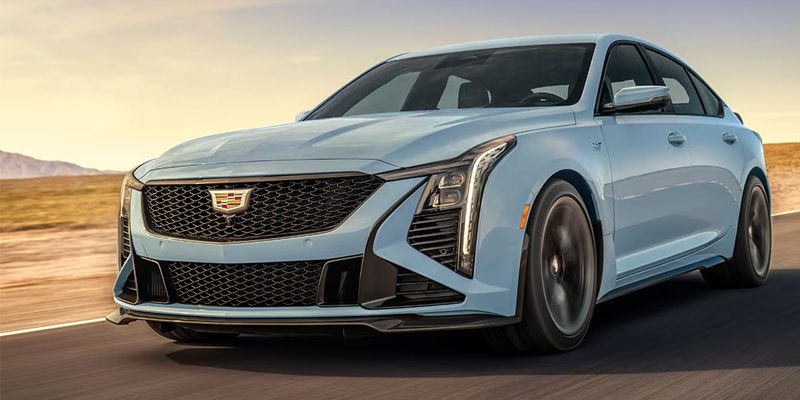
The CT5-V and CT5-V Blackwing share a nameplate, a platform, and a body. The two cars are separated by roughly $40,000, 308 horsepower, and a fundamental difference in driving intent. One is a sport sedan that balances daily comfort with genuine driving capability. The other is a hand-built, track-ready machine that happens to function as a daily driver. Understanding where the two cars diverge at the hardware level makes the decision straightforward.
The Powertrain Gap: Twin-Turbo V6 vs Supercharged V8
The CT5-V uses a 3.0L twin-turbo V6 producing 360 horsepower and 405 lb-ft of torque. The CT5-V Blackwing uses a 6.2L supercharged V8 producing 668 horsepower and 659 lb-ft of torque. That gap is 308 horsepower and 254 lb-ft of torque. Both figures are significant. That torque difference is what shapes how each car feels at everyday driving speeds.
The twin-turbo V6 builds boost as exhaust energy accumulates. Peak torque arrives higher in the RPM range as a result. The engine pulls strongly from 2,500 RPM upward and delivers a 4.6-second 0-60 time. That is quick for a full-size sport sedan. The supercharged V8 in the Blackwing operates differently. Boost is mechanically driven from the crankshaft at all times. The full torque figure is available from low RPM. The engine does not need to build into a power band first. The result is 3.4 seconds to 60 mph and an engine character that feels immediate at any throttle position.
Read the rest of this entry »What to Expect at Your Cadillac Service Appointment
A Cadillac service appointment follows a defined process from check-in through pickup. Knowing what that process looks like removes most of the uncertainty surrounding a dealership visit. Each step serves a purpose. Understanding those purposes helps owners arrive prepared and ask the right questions. Leaving with confidence that the work is documented correctly starts at check-in.

Check-In and What the Advisor Is Documenting
The service advisor is your primary point of contact from the moment you arrive. At check-in, the advisor records your vehicle’s mileage, confirms the vehicle identification number, and documents your concern description in detail. That documentation is not administrative routine. It is the foundation of the repair order, which drives every action taken on your vehicle during the visit.
Concern description accuracy matters more than most owners realize. When warranty work is involved, the manufacturer requires three things on the repair order. The complaint, the cause, and the correction must all appear before a claim is authorized. A vague concern description creates a documentation gap. It can delay warranty authorization or require a return visit to correct the record. A specific description gives the technician a documented starting point. It also gives the advisor language that aligns with warranty claim requirements. “Intermittent clicking from the front left suspension at low speed over rough pavement” is an example of that level of detail.
Read the rest of this entry »Escalade V Performance: Supercharged Power Explained
Escalade V performance begins with a figure that stops most conversations cold. A 6,200-pound full-size SUV reaches 60 mph in 4.4 seconds. That number is not a track-only result. It is repeatable in standard trim, on public roads, in full-size three-row SUV form. However, understanding why that figure is possible means looking past the horsepower rating. The engineering behind it is what makes that number credible at this weight.
The Supercharged 6.2L V8: How 682 Horsepower Works
The Escalade V is powered by a hand-built, signed 6.2L supercharged V8 producing 682 horsepower and 653 lb-ft of torque. The supercharger is an Eaton TVS 2650 positive displacement unit mounted in the valley of the engine. It differs from a turbocharger in one critical way: it is mechanically driven by the crankshaft rather than exhaust gas. As a result, boost pressure builds immediately at engine startup. There is no lag period while exhaust energy accumulates.
That distinction matters at the weights and speeds where most driving occurs. At 1,500 to 3,500 RPM, the supercharged V8 delivers the majority of its torque. That range covers city acceleration, highway merging, and passing maneuvers. The engine does not need to be wound up to produce force. Force is available from the moment the throttle opens. Paired with a 10-speed automatic transmission, the drivetrain manages gear selection precisely. It keeps the engine planted inside that torque band across a wide range of inputs. The result is acceleration that feels immediate rather than building progressively.
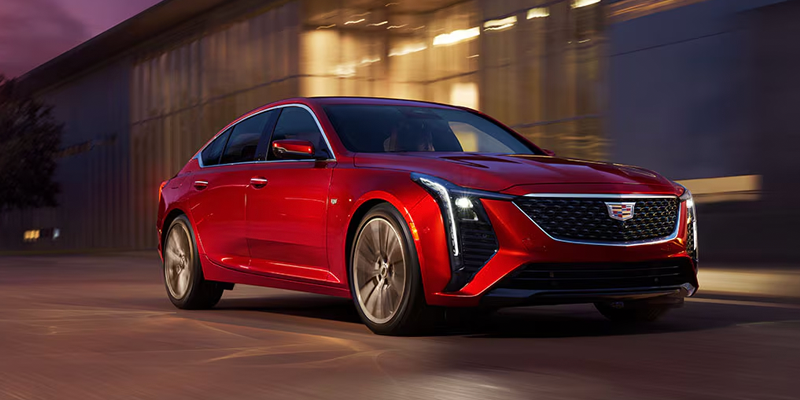
Read the rest of this entry »Shopping for a used Cadillac sedan under $30,000 brings two strong options forward: the ATS and the CT4. Both carry rear-wheel drive architecture, turbocharged powertrains, and a driving character that separates them from most compact rivals. Moreover, knowing which model year to target and what to inspect gives shoppers a clear advantage. Understanding how the platforms differ sharpens that advantage further.
What Your Budget Gets You by Model Year
The $30,000 ceiling defines a specific range in the used Cadillac sedan market. At the lower end, shoppers find ATS models from 2015 through 2017 in base trim with rear-wheel drive. These examples carry the 2.0L turbocharged four-cylinder and a genuine sport chassis. However, they require close attention to maintenance history. The $22,000 to $27,000 range opens access to 2018 and 2019 ATS Premium examples. Early CT4 models from 2020 and 2021 in base trim also land in that window. At the $27,000 to $30,000 ceiling, shoppers find 2021 and 2022 CT4 Premium sedans. Those carry upgraded interior materials and the updated Cadillac User Interface.
Read the rest of this entry »Air Suspension vs Magnetic Ride in Cadillac SUVs
Air suspension vs magnetic ride comparisons have become increasingly common among Cadillac shoppers trying to understand why Escalade ride quality feels different from traditional SUV suspension setups. Cadillac uses multiple adaptive suspension technologies to manage body movement, road isolation, steering response, and passenger comfort during driving. Buyers researching these systems are usually trying to understand what changes physically underneath the SUV, how the suspension reacts while driving, and what ownership considerations exist years after purchase.

Cadillac Magnetic Ride Control Changes Damping in Real Time
What is Cadillac Magnetic Ride Control? Magnetic Ride Control is an adaptive damping suspension technology that changes shock absorber firmness electronically by using magnetically responsive fluid inside the dampers.
Inside each shock absorber is a fluid containing microscopic metallic particles. When electrical current passes through the suspension system, those particles react almost instantly, changing the fluid resistance inside the damper. That resistance controls how quickly the suspension compresses and rebounds over bumps, pavement transitions, braking, and cornering.
The suspension sensors continuously monitor wheel movement and road surface changes while the SUV is in motion. The control module processes that information rapidly and adjusts damping force almost immediately. This allows the suspension to tighten during sharper body movement while remaining softer during smoother highway travel.
In Cadillac SUVs like the CT5, Magnetic Ride Control changes how the body reacts over uneven pavement. Instead of allowing larger body motions after bumps or lane changes, the adaptive dampers manage vertical movement more tightly.
This creates noticeable differences during:
Read the rest of this entry »Cadillac pricing includes more than the vehicle MSRP alone, which is why buyers researching fees, taxes, protection plans, and financing paperwork want a clearer breakdown before signing documents. Vehicle purchases involve multiple pricing layers tied to registration processing, financing structure, dealership administration, and optional ownership protection products. Buyers walking into a finance office are not only evaluating the vehicle itself. They are reviewing legal ownership transfer, lender documentation, state filing requirements, and optional financial protection decisions that shape the final transaction total.

MSRP and Out The Door Pricing Are Not the Same Number
What is included in Cadillac pricing? MSRP represents the manufacturer’s suggested retail price before taxes, registration, financing products, and dealership processing fees are added to the transaction.
Many buyers researching Cadillac pricing focus first on the advertised vehicle amount without realizing the final out the door figure includes multiple additional components. Out the door pricing refers to the complete purchase total after all required taxes, state registration costs, title filing charges, and applicable dealership processing fees are included.
This distinction matters because two buyers purchasing similarly priced vehicles can still see different transaction totals depending on local tax structure, registration requirements, trade equity, lender terms, and optional products selected during financing.
Vehicle pricing structures commonly include:
Read the rest of this entry »Does Cadillac Have a Hybrid? EV Options Explained
Does Cadillac have a hybrid vehicle available today is one of the most common questions from shoppers researching electric SUVs, plug in hybrids, and the transition away from traditional gasoline drivetrains. Cadillac’s lineup direction has shifted heavily toward fully electric vehicles, which creates confusion for buyers trying to understand the difference between hybrid technology, plug in hybrid setups, and battery electric SUVs. Some drivers are still comparing gasoline ownership routines against charging routines for the first time, while others are evaluating whether a fully electric Cadillac fits their commuting habits, travel expectations, and comfort preferences.
Cadillac’s Shift Toward Fully Electric Vehicles
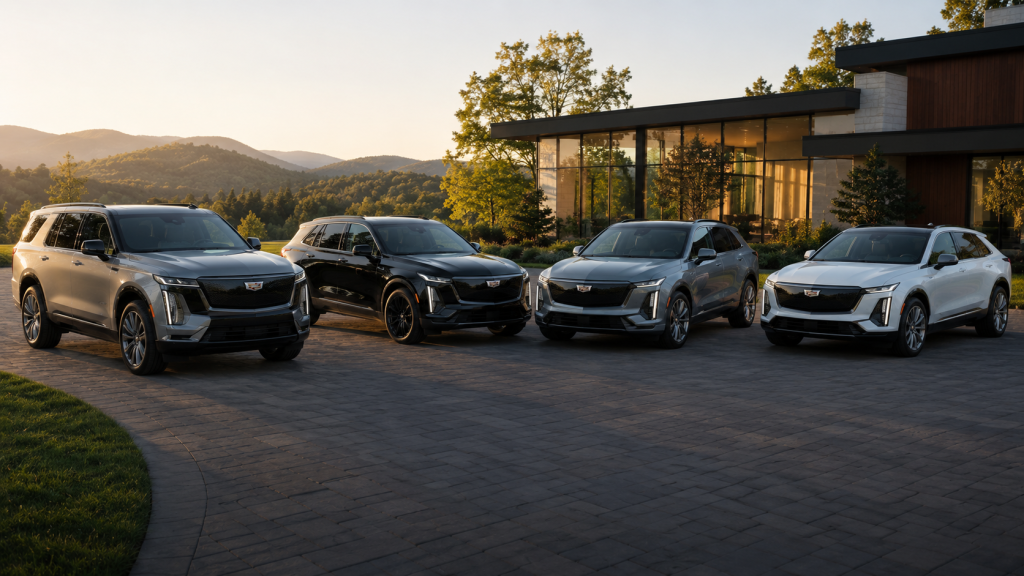
Does Cadillac currently make a hybrid vehicle? Cadillac previously explored hybrid technology years ago, but the brand’s current direction centers on battery electric vehicles instead of introducing new hybrid or plug in hybrid models into the lineup.
The clearest example is the Cadillac LYRIQ, which uses a fully electric drivetrain powered entirely by battery energy instead of combining gasoline and electric propulsion. This means there is no gasoline engine operating alongside the electric motors. The SUV relies completely on stored electrical energy delivered through its battery pack.
That distinction matters because many shoppers searching for a hybrid Cadillac are really trying to understand where the brand fits within the broader electrification shift happening across the automotive industry. Some manufacturers continue offering traditional hybrid SUVs that combine gasoline engines with smaller electric motors. Cadillac instead focused its strategy around larger battery electric architecture and dedicated EV platforms.
This transition changes multiple aspects of ownership:
Read the rest of this entry »Cadillac 3 Row SUV: Escalade vs XT6 Guide
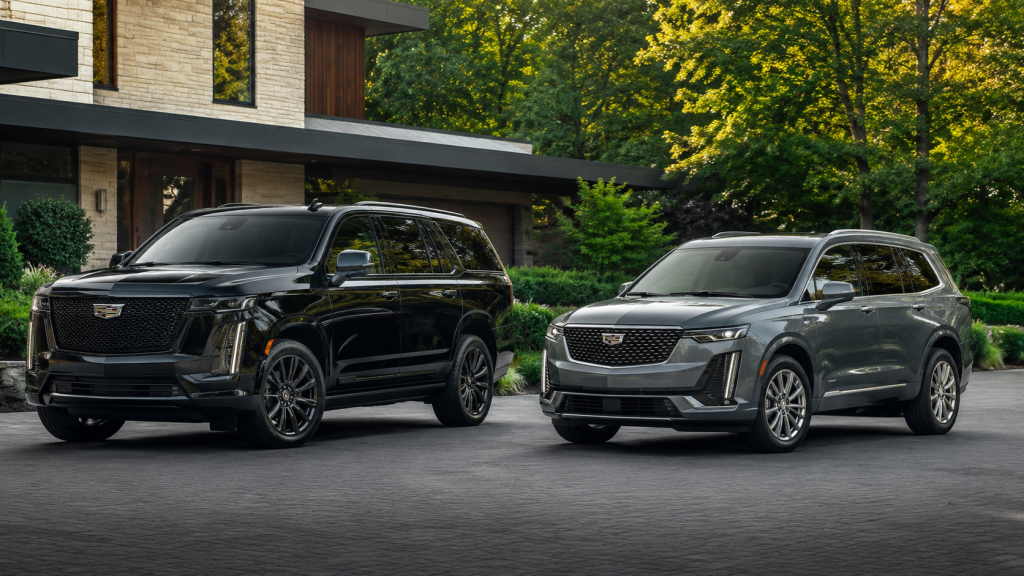
Cadillac 3 row SUV shoppers comparing the Escalade and XT6 are usually trying to balance passenger comfort, cargo flexibility, commuting size, and family travel needs before choosing the right layout. Both SUVs offer three rows, advanced cabin technology, and family focused interiors, but they approach space, ride feel, and passenger movement very differently. Families researching these Cadillac models are not only comparing dimensions. They are evaluating how each SUV fits school pickup routines, highway travel, garage space, luggage planning, and passenger comfort across all seating rows.
Third Row Seating and Passenger Space
Which Cadillac SUV has more usable third row space? Third row usability refers to how comfortably passengers can sit, enter, exit, and remain seated during longer drives without excessive leg restriction or limited headroom.
The Escalade approaches passenger space with a larger cabin footprint and a longer wheelbase. That added length creates more separation between seating rows, which changes how passengers move throughout the interior. Adults sitting in the third row usually notice more knee space and easier seating posture during highway trips or longer family drives.
The XT6 takes a different approach. Its cabin is more compact overall, which creates easier maneuverability outside the vehicle while tightening rear passenger spacing slightly. Families with younger children or shorter trips may find the third row layout fully manageable, but buyers transporting older teenagers or adults regularly should spend time evaluating rear seating comfort directly.
Read the rest of this entry »Cadillac design continues to move forward by integrating digital systems that feel as intentional as the physical controls they replace. The display inside a Cadillac is not just a screen. It is the central interface that connects navigation, communication, vehicle settings, and driver awareness into one cohesive system. When that system does not respond as expected, the uncertainty is not just about the screen itself. It is about understanding whether the issue is temporary, system based, or something that requires deeper service. Knowing how these systems function creates clarity, allowing drivers to respond with confidence instead of guesswork.
How Cadillac Infotainment Systems Work Behind The Screen
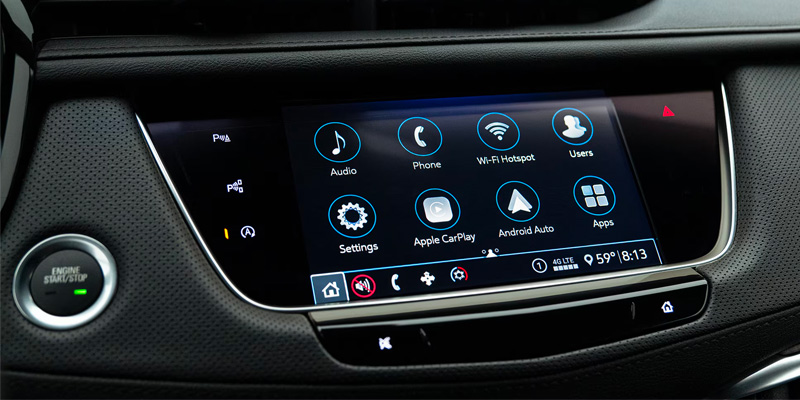
Many drivers ask why their Cadillac screen stops working, but that question begins with how the system is built. A Cadillac infotainment system operates as a network of hardware and software components working together to process input, display information, and respond to commands.
In a vehicle like the Cadillac Escalade, the display is only one part of the system. Behind it, a control module processes data, manages inputs from touch and physical controls, and communicates with other vehicle systems.
The system relies on continuous communication between components.
Read the rest of this entry »For more than a century, Cadillac has moved forward by defining what comes next rather than repeating what came before. That progression is especially visible in the Escalade, where each generation reflects a shift in how design, technology, and performance come together. When considering a used Cadillac Escalade, the question is rarely just which year is best. It becomes a question of how each generation was built, what changed beneath the surface, and how those changes shape ownership over time. Understanding Escalade model years through platform evolution provides clarity that simple lists cannot.
How Escalade Generations Are Defined By Platform Changes
Many drivers ask what the best year for a Cadillac Escalade is, but that question begins with how generations are defined. A generation represents a complete redesign of the vehicle’s platform, meaning changes to structure, suspension, technology integration, and system architecture.
In earlier Escalade generations, the focus was on durability and mechanical strength. These models relied on proven V8 systems and simpler electronic integration, which created a consistent and familiar ownership experience.
As the Escalade evolved, each generation introduced new systems that changed how the vehicle behaved and how drivers interacted with it.
Read the rest of this entry »Connect with us