


When comparing the Cadillac XT5 and XT6, the decision centers on space architecture, seating configuration, and how each vehicle supports daily use. Both SUVs share Cadillac’s design language and available powertrains, but they are engineered for different ownership priorities. One prioritizes two-row balance and maneuverability. The other is built around three-row flexibility and expanded passenger capacity.
Understanding how their platforms, dimensions, and interior packaging differ is what makes the comparison meaningful.
Platform and Size: How Much Larger Is the XT6?
The XT5 is classified as a midsize two-row SUV. The XT6 is a longer, three-row midsize SUV built on an extended wheelbase version of GM’s C1 platform.
Key dimensional differences:
- Overall Length
- XT5: Approximately 189.6 inches
- XT6: Approximately 198.5 inches
The XT6 is nearly nine inches longer, which directly supports third-row packaging and added cargo volume.
- Wheelbase
- XT5: Around 112.5 inches
- XT6: Around 112.7 inches
While the wheelbase difference is modest, the XT6 uses its extended body length to optimize rear seating geometry.
- Seating Capacity
- XT5: 5 passengers
- XT6: 6 or 7 passengers depending on second-row configuration
The XT5’s shorter overall length makes it easier to maneuver in tighter urban environments. The XT6 sacrifices a small degree of compact feel in exchange for third-row practicality.
Interior Layout and Passenger Comfort
The most significant difference between these SUVs is seating architecture.
XT5 Interior Configuration
The XT5 is engineered around a two-row layout with generous second-row legroom and flexible cargo storage. Its rear seat slides and reclines, allowing owners to balance passenger comfort with cargo needs.
Highlights:
- Spacious second-row legroom for adult passengers
- Flat load floor when rear seats are folded
- Lower step-in height for easier entry
- Cabin proportions focused on five-passenger comfort
The XT5 prioritizes second-row comfort over maximum passenger count. For families with one or two children, it provides more usable daily space than a cramped third row would.
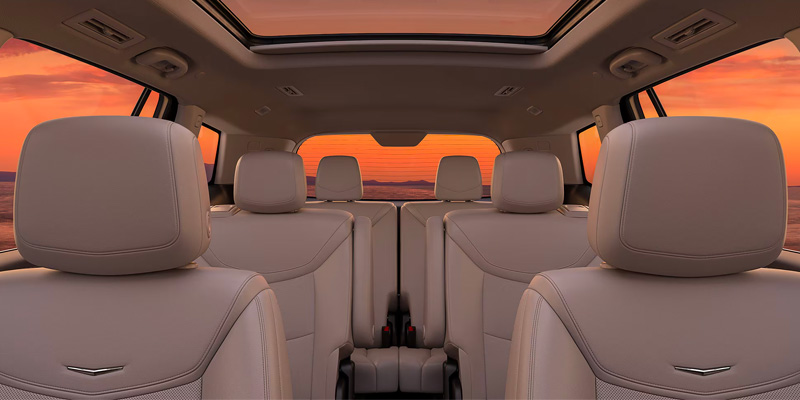
XT6 Interior Configuration
The XT6 introduces a true third row, available with either:
- Second-row captain’s chairs for six passengers
- A second-row bench for seven passengers
Important third-row realities:
- Best suited for children or shorter adults on longer drives
- Legroom is adequate but not expansive
- Designed for flexibility rather than constant full occupancy
Cargo space behind the third row is usable for grocery runs and small luggage. With the third row folded, the XT6 transforms into a large two-row cargo hauler.
The XT6 exists for households that occasionally or frequently need extra seating capacity.
Cargo Space Comparison
Cargo volume is one of the most researched elements in this comparison.
XT5 Cargo Capacity:
- Behind second row: Approximately 30 cubic feet
- With rear seats folded: Around 63 cubic feet
XT6 Cargo Capacity:
- Behind third row: Approximately 12 cubic feet
- Behind second row: Around 43 cubic feet
- With second and third rows folded: About 78 cubic feet
The XT5 offers more cargo space than the XT6 when both are configured as two-row vehicles. The XT6 surpasses it when fully opened up with all seats folded.
This means:
- If you rarely use a third row, the XT5 may provide more everyday cargo efficiency.
- If you need flexible seating plus large hauling capability, the XT6 offers greater overall volume.
Powertrain and Performance Differences
Both SUVs offer similar engine options, but how they are positioned matters.
Standard Engine:
- 2.0L turbocharged inline-four
- Approximately 235 horsepower
- Paired with a 9-speed automatic transmission
Available Upgrade:
- 3.6L V6
- Approximately 310 horsepower
- Enhanced passing and merging performance
Drive Configuration:
- Front-wheel drive standard
- Available all-wheel drive
Driving Behavior:
The XT5 feels lighter and slightly more responsive in city driving due to its shorter length and marginally lower weight.
The XT6, particularly with the V6, feels more composed under load and better suited for highway cruising with multiple passengers.
Fuel Economy:
- XT5 typically returns slightly better combined MPG due to lower mass.
- XT6 efficiency depends on drivetrain and seating configuration.
Towing Capability
Towing is another decision point for some buyers.
- XT5 maximum towing capacity: Around 3,500 pounds with proper equipment
- XT6 maximum towing capacity: Up to 4,000 pounds when properly equipped
The XT6 provides a modest edge for light trailers, small boats, or recreational equipment.
Ride Quality and Handling
Both vehicles reflect Cadillac’s tuning philosophy: quiet cabins, composed suspension calibration, and controlled steering input.
XT5 Ride Character:
- Slightly more agile feel
- Less body movement in tight turns
- Ideal for daily commuting
XT6 Ride Character:
- Stable under full passenger load
- Balanced suspension tuned for family comfort
- Longer body enhances highway stability
Neither SUV is performance-oriented in this segment comparison. The focus is isolation, smoothness, and refinement.
Trim Strategy and Feature Alignment
Both models are typically available in:
- Luxury
- Premium Luxury
- Sport
Premium Luxury focuses on comfort and chrome exterior detailing.
Sport trims introduce:
- Darker exterior accents
- Performance-tuned suspension
- Standard all-wheel drive in many configurations
Technology and safety systems largely mirror each other across comparable trims, including advanced driver assistance features and Cadillac’s infotainment platform.
Which Cadillac SUV Is Right for You?
Choose the XT5 if:
- You do not need a third row
- Maneuverability and second-row comfort matter most
- You want maximum cargo space in a two-row format
- You prioritize slightly higher fuel efficiency
Choose the XT6 if:
- You need six or seven passenger flexibility
- You frequently transport additional family members
- You want greater maximum cargo capacity when seats are folded
- You prefer added highway stability with a larger body
The decision is not about one being better. It is about how often that third row will truly be used.
Both SUVs represent Cadillac’s approach to purposeful design, where interior packaging and engineering intent shape the ownership experience rather than marketing labels.
For buyers comparing these two vehicles in depth, understanding seating architecture and daily usage patterns will lead to the right choice.
Connect with us