


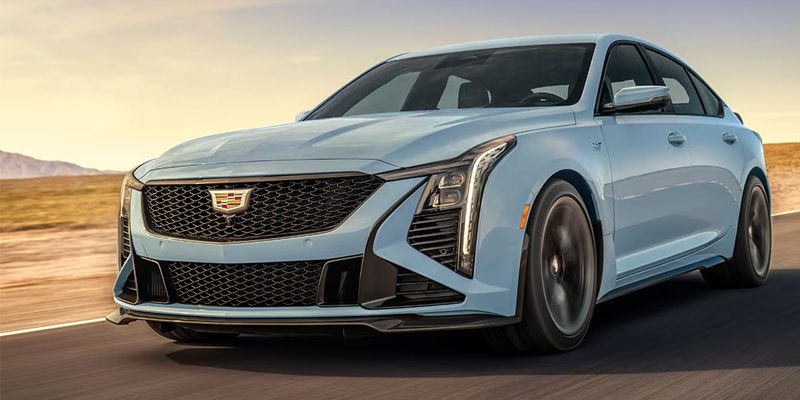
The CT5-V and CT5-V Blackwing share a nameplate, a platform, and a body. The two cars are separated by roughly $40,000, 308 horsepower, and a fundamental difference in driving intent. One is a sport sedan that balances daily comfort with genuine driving capability. The other is a hand-built, track-ready machine that happens to function as a daily driver. Understanding where the two cars diverge at the hardware level makes the decision straightforward.
The Powertrain Gap: Twin-Turbo V6 vs Supercharged V8
The CT5-V uses a 3.0L twin-turbo V6 producing 360 horsepower and 405 lb-ft of torque. The CT5-V Blackwing uses a 6.2L supercharged V8 producing 668 horsepower and 659 lb-ft of torque. That gap is 308 horsepower and 254 lb-ft of torque. Both figures are significant. That torque difference is what shapes how each car feels at everyday driving speeds.
The twin-turbo V6 builds boost as exhaust energy accumulates. Peak torque arrives higher in the RPM range as a result. The engine pulls strongly from 2,500 RPM upward and delivers a 4.6-second 0-60 time. That is quick for a full-size sport sedan. The supercharged V8 in the Blackwing operates differently. Boost is mechanically driven from the crankshaft at all times. The full torque figure is available from low RPM. The engine does not need to build into a power band first. The result is 3.4 seconds to 60 mph and an engine character that feels immediate at any throttle position.
The Blackwing engine is hand-assembled and each unit is signed by the technician who built it. That process reflects both the output level and the manufacturing tolerances required to sustain it.
Transmission: Automatic Only vs Manual Available
The CT5-V is available exclusively with a 10-speed automatic transmission. The CT5-V Blackwing offers a choice: the same 10-speed automatic or a 6-speed manual. That option is one of the most significant features separating the two cars. It requires context to evaluate correctly.
A 6-speed manual in a 668-horsepower rear-wheel-drive sedan is a specific ownership proposition. On a track day, the manual gives the driver direct control over gear selection and rev matching. No automatic replicates that connection. The engagement is complete. Every gear change is a physical action with mechanical consequence. The manual Blackwing is one of very few cars in its class that still offers that connection.
By contrast, in daily driving, the manual requires more attention in traffic and adds fatigue on long highway trips. The 10-speed automatic Blackwing is the more practical choice for mixed-use owners. That version loses none of the engine’s character. The automatic holds gears aggressively in Sport and Track modes. It responds to paddle shifters with a precision that most dual-clutch units would not improve on. The choice between them comes down to how the owner plans to use the car.
Chassis and Suspension: AWD Option vs RWD Only
The CT5-V is available in rear-wheel drive as standard or all-wheel drive as an option. That choice is not available on the Blackwing. The CT5-V Blackwing is rear-wheel drive only. That distinction is worth understanding before the purchase decision. It matters most for owners in climates where winter driving is a consistent concern.
The Blackwing is RWD only by engineering intent. At 668 horsepower and 659 lb-ft of torque, routing power through an AWD system would require significant drivetrain compromises. Those compromises would blunt the balanced chassis response that defines the Blackwing’s character. The rear-wheel-drive layout keeps weight distribution centered and gives the chassis a direct, predictable response to throttle inputs. That is the setup that produces the Blackwing’s driving dynamics. AWD would blunt both the character and the balance.
Both cars use Magnetic Ride Control, but the calibrations are different. The CT5-V’s MRC setup prioritizes a dual-character range between comfort and sport driving. The Blackwing’s MRC calibration is tuned further toward the aggressive end of the range. In Tour mode, the Blackwing is still composed and liveable on a daily commute. In Sport and Track modes, the dampers stiffen to a degree that the CT5-V’s calibration does not reach. That extended range is what makes the Blackwing function credibly on a track. A dedicated track car is not required to use it.
Brakes: What Changes at All Four Corners
The CT5-V uses Brembo front brake calipers paired with standard rear calipers. The CT5-V Blackwing uses Brembo calipers at all four corners. Six-piston units up front, four-piston units in the rear. That is not a cosmetic upgrade. It is a direct response to the stopping demands the Blackwing creates. It is a hardware requirement given the Blackwing’s output and the stopping demands that follow from it.
At 3.4 seconds to 60 mph, the kinetic energy the Blackwing generates under acceleration creates a corresponding braking obligation. Brembo rear calipers distribute brake force across the full axle. That improves straight-line stopping stability and reduces front axle load under hard deceleration. That load reduction is what prevents front brake fade under repeated high-speed stops. On a track, that difference becomes measurable. Pedal consistency holds across multiple hard braking zones in a way that front-only hardware does not sustain.
The Blackwing also receives larger rotor diameters front and rear compared to the CT5-V. Greater rotor diameter increases leverage available to each caliper. That lowers the pedal effort required to produce a given deceleration force. The Blackwing’s brake system is more capable under sustained load. It is also more responsive at moderate braking inputs.
Exterior and Interior: How to Tell Them Apart
The CT5-V and CT5-V Blackwing share the same body shell, which means visual differentiation requires knowing where to look. Several exterior details distinguish the Blackwing from the standard V. That differentiation requires knowing where to look.
The Blackwing has functional front brake cooling vents behind the front wheel openings. Those openings feed air directly to the front brake rotors and are absent on the CT5-V. The rear diffuser on the Blackwing is more aggressive in depth and angle. The rear exhaust tips are quad-exit on the Blackwing compared to the dual-exit setup on the CT5-V. The Blackwing also receives a larger front splitter. Available carbon fiber exterior trim is exclusive to the Blackwing and not offered on the CT5-V.
- The Blackwing’s interior carries a serialized build plate showing the unit number in the production sequence. That detail is specific to the hand-build program and does not appear in the CT5-V.
- Carbon fiber trim packages are available exclusively on the Blackwing. Those include carbon fiber seat backs, door inserts, and steering wheel trim that are not offered at any price on the standard V.
- Both cars share the same 33-inch diagonal curved display and the Super Cruise hands-free driving system. Interior space, seating, and technology content are functionally identical between the two models.
The practical takeaway is that the two cars are nearly indistinguishable to casual observation. The brake cooling vents and exhaust tip configuration are the most reliable visual identifiers at a distance.
Price Gap Breakdown: What the $40,000 Buys
The CT5-V starts at approximately $57,600. The CT5-V Blackwing starts at approximately $97,600. That $40,000 gap is the most searched question in this comparison and the least answered. That breakdown follows in hardware terms.
The largest single cost driver is the powertrain. The 6.2L supercharged V8 is hand-assembled and signed. That reflects both the parts cost and the labor investment of the build program. The Eaton supercharger, the hand-assembly process, and the output-specific internal components are not shared with any other Cadillac model. That exclusivity is a direct cost driver. The full Brembo brake system at all four corners adds cost over the front-only configuration in the CT5-V. The more aggressive MRC calibration is specific to the Blackwing. The additional chassis tuning work also does not carry over from the standard V platform.
The 6-speed manual transmission option adds development and tooling cost that is exclusive to the Blackwing. The carbon fiber program, the serialized build plate, and the exclusive exterior cooling hardware are each Blackwing-specific. Against direct competitors, the Blackwing’s pricing aligns with the BMW M3 and sits slightly below the Mercedes-AMG C63. Both European rivals carry similar or higher starting prices for comparable output. The Blackwing adds the manual option and the hand-build program. Those competitors do not consistently match that combination at this price point.
The CT5-V at $57,600 suits the owner who wants sport sedan capability and AWD availability. It does not require commitment to the Blackwing’s focused intent and price. The Blackwing at $97,600 is for the owner who wants one of the last manual-transmission V8 sport sedans of its generation. That proposition is specific. It is also exactly right for the buyer it suits.
Connect with us